Author

admin

Browsing

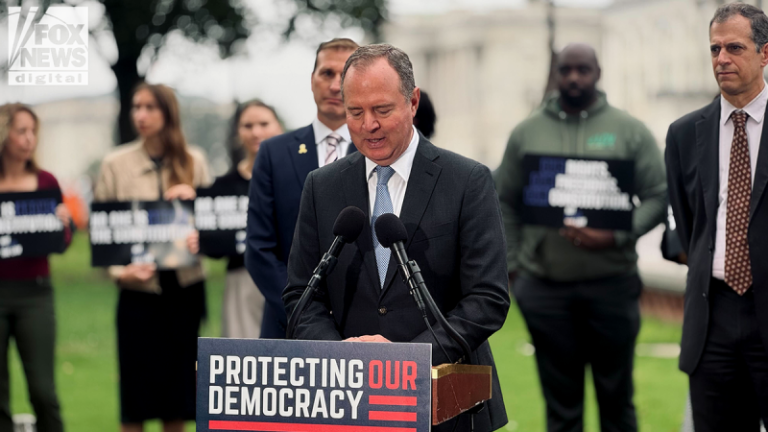
Sen. Adam Schiff, D-Calif., sharply criticized Kash Patel’s tenure as FBI director Wednesday, telling reporters that he viewed Patel’s leadership as deeply partisan and a ‘terrible tragedy’ for the nation’s sprawling law enforcement agency. 

Speaking at a news conference alongside former House Speaker Nancy Pelosi, D-Calif., and other House Democrats, Schiff took umbrage at Patel’s testimony one day earlier before the Senate Judiciary Committee, which Schiff said further crystallized his concerns about politicization within the bureau.

The FBI ‘has been the premier law enforcement agency in the country, and the world, because they’ve been constantly professional and non-partisan,’ Schiff said Wednesday, noting the close working relationship he had with FBI agents during the years he spent as a federal prosecutor. 

‘It is a terrible tragedy, I think, for the men and women of the bureau to have such poor leadership that is replacing expertise with incompetence, that is replacing non-partisanship with the most rabid partisanship,’ Schiff told Fox News Digital. ‘And this is not unrelated to why we’re here today.’

His remarks come as Patel appeared on Capitol Hill Wednesday for a second day of testimony before the Senate and House Judiciary committees.

Both hearings were marked by sharp lines of questioning from Democrats, who grilled Patel on issues ranging from a flurry of FBI firings, the bureau’s handling of the Epstein files and concerns of politicization, among many other topics.

Schiff, in particular, pressed Patel on his tenure at the FBI, saying the bureau’s agents — mostly assigned to its 52 field offices across the country and loath to see their work politicized — wanted to know what, if any, marching orders Patel had received from President Donald Trump.

The heated back-and-forth devolved into a shouting match between the two as Schiff pressed Patel repeatedly on the firings of FBI agents and whether those individuals were removed for political reasons.

Patel, for his part, described Schiff as a ‘political buffoon.’ 

Speaking to reporters Wednesday, Schiff said Patel’s appearance did little to assuage his broader fears of weaponization within the bureau.

‘You can’t have a vibrant democracy without the rule of law,’ he told Fox News Digital. ‘You can’t have the rule of law if you have a weaponized FBI and a weaponized Justice Department, and, sadly, that’s what we have here today,’ Schiff said.

He also weighed in on Patel’s remarks yesterday on the Epstein files, another issue that sparked intense criticism from lawmakers, after Patel claimed Tuesday that there was ‘no credible evidence’ that Jeffrey Epstein was trafficking women other than for himself. 

Schiff said it was a ‘startling claim,’ particularly from someone who had previously promoted the belief that Epstein maintained a vast client list of powerful people.

‘So, it was completely contradictory to everything he said in the past,’ he said. He also noted Patel’s ‘refusal’ to answer his questions on why Deputy Attorney General Todd Blanche declined to press Ghislaine Maxwell further on the Cabinet members she identified as being ‘close’ to Epstein or having a relationship with him during a two-day interview in July.

‘Blanche refused to ask who they were and just ignored her comment,’ Schiff added. 

‘And this is, again, the kind of incompetence we’re seeing,’ he said. ‘Incompetence is probably the most polite thing I can describe, but it certainly looks like a cover-up.’

The Justice Department and FBI have struggled to quell the mounting public pressure on them to release more information related to the Epstein investigation, underscoring the story’s sticking power in a fast-moving news cycle and among Trump supporters, who have been some of the leading voices in demanding the information be released.

This post appeared first on FOX NEWS

Jerry Greenfield, co-founder of the Ben & Jerry’s ice cream brand, has stepped down from the company he started 47 years ago citing a retreat from its campaigning spirit under parent company Unilever.

Greenfield wrote in an open letter late Tuesday night — shared on X by his co-founder Ben Cohen — that he could no longer ‘in good conscience’ remain an employee of the company and said the company had been ‘silenced.’

He said the company’s values and campaigning work on ‘peace, justice, and human rights’ allowed it to be ‘more than just an ice cream company’ and said the independence to pursue this was guaranteed when Anglo-Dutch packaged food giant Unilever bought the brand in 2000 for $326 million.

Cohen’s statement didn’t mention Israel’s ongoing military operation in Gaza, but Ben & Jerry’s has been outspoken on the treatment of Palestinians for years and in 2021 withdrew sales from Israeli settlements in what it called ‘Occupied Palestinian Territory.’

Greenfield’s resignation comes five months after Ben & Jerry’s filed a lawsuit accusing Unilever of firing its chief executive, David Stever, over his support for the brand’s political activism. In November last year Ben & Jerry’s filed another lawsuit accusing Unilever of silencing its public statements in support of Palestinian refugees.

‘It’s profoundly disappointing to come to the conclusion that that independence, the very basis of our sale to Unilever, is gone,’ Greenfield said.

‘And it’s happening at a time when our country’s current administration is attacking civil rights, voting rights, the rights of immigrants, women, and the LGBTQ community,’ he added.

Jerry Greenfield, left, and Bennett Cohen, the founders of Ben and Jerry’s founders, in Burlington, Vt., in 1987.Toby Talbot / AP file

Richard Goldstein, the then president of Unilever Foods North America, said in a statement after the sale in 2000 that Unilever was ‘in an ideal position to bring the Ben & Jerry’s brand, values and socially responsible message to consumers worldwide.’

But now Greenfield claims Ben & Jerry’s ‘has been silenced, sidelined for fear of upsetting those in power.’ He said he would carry on campaigning on social justice issues outside the company.

The financial performance of the Ben & Jerry’s brand isn’t made public but Unilever’s ice cream division made 8.3 billion Euros ($9.8 billion) in revenue in 2024. Unilever is in the process of spinning off its ice cream division, however, into a separate entity which involves cutting some 7,500 jobs across its brands globally.

Cohen and Greenfield founded the business in 1978 in Burlington, Vermont, where it is still based.

NBC News has contacted Unilever for comment overnight but had not received any at the time of publication.

This post appeared first on NBC NEWS

Markets don’t usually hit record highs, risk falling into bearish territory, and spring back to new highs within six months. But that’s what happened in 2025.

In this special mid-year recap, Grayson Roze sits down with David Keller, CMT, to show how disciplined routines, price-based signals, and a calm process helped them ride the whipsaw instead of getting tossed by it. You’ll see what really happened under the surface, how investor psychology drove the swings, and the exact StockCharts tools they leaned on to stay objective. 

If you’re focused on protecting capital, generating income, and sleeping well at night while still capturing the upside, this is a must-watch. Discover which charts deserve your attention now, what to ignore, and how to prep for the back half of 2025. 

This video premiered on July 23, 2025. Click on the above image to watch on our dedicated Grayson Roze page on StockCharts TV.

You can view previously recorded videos from Grayson at this link.

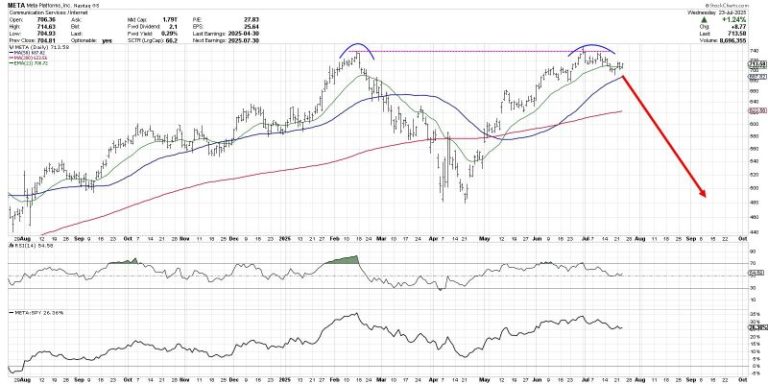
The chart of Meta Platforms, Inc. (META) has completed a roundtrip from the February high around $740 to the April low at $480 and all the way back again.  Over the last couple weeks, META has now pulled back from its retest of all-time highs, leaving investors to wonder what may come next.

Is this the beginning of a new downtrend phase for META?  Or just a brief pullback before a new uptrend phase propels META to new all-time highs?

Today we’ll look at two potential scenarios, including the double top pattern and the cup and handle pattern, and share which technical indicators and approaches could help us determine which path plays out into August.

The double top scenario basically means that the late July retest of the previous all-time high was the end of the recent uptrend phase.  The double top pattern is literally when a major resistance level is set and then retested.  The implication is that a lack of willing buyers means the uptrend is exhausted, and there is nowhere to go but down.

While the 21-day exponential moving average is currently in play for META, I would say that a break below the 50-day moving average could confirm this as the correct scenario.  If that smoothing mechanism does not hold, then the price action would imply less of a pullback and more like the beginning of a real distribution phase.

What is META pulls back but then resumes an uptrend phase, leading META to another new all-time high?  That would result in a confirmed cup and handle pattern, created by a large rounded bottoming pattern followed by a brief pullback.  The key to this pattern is the “rim” of the cup, which sits right at $740 for META.

Given the pullback META has demonstrated so far in July, I would say that a break above the $740 level would basically confirm a bullish cup and handle pattern.  That would suggest much more upside potential for META, as the stock would literally go into previously uncharted territory.

So how can we determine which scenario is more likely to play out?  This is where we need to incorporate more technical indicators into the discussion, as a way to further validate and confirm our investment thesis.

Just to review, I think a break above $740 would confirm a bullish cup and handle pattern.  I would also say that a break below the $680 level, which would represent a move below the 50-day moving average as well as the June swing lows, would basically confirm a bearish double top pattern.

We can also use the Relative Strength Index (RSI) to help determine whether META remains in a bullish trend phase.  During bull phases, the RSI rarely gets below 40, because buyers usually step in to “buy the dips” and keep the momentum fairly constructive.  So if the price would break down, and the RSI would not hold that crucial 40 level, that could mean a bearish outlook is warranted.

Finally, we can use volume-based indicators to assess whether moves in the price are supported by stronger volume readings.  Here I’ve included the Accumulation/Distribution Line, which tracks the trend in daily volume readings over time.  We can see that the high in July resulted in a divergence, as the A/D line was trending lower.  If the A/D line would break below its June and July lows, marked by a dashed red line, that would represent a bearish volume reading for META.

Technical analysis is less about predicting the future, and more about determining the most probable scenarios based on our analysis of trend, momentum, and volume.  I hope this discussion shows how the outlook for META can be easily determined and tracked using the best practices of technical analysis!

RR#6,

Dave

PS- Ready to upgrade your investment process?  Check out my free behavioral investing course!

David Keller, CMT

President and Chief Strategist

Sierra Alpha Research LLC

marketmisbehavior.com

https://www.youtube.com/c/MarketMisbehavior

Disclaimer: This blog is for educational purposes only and should not be construed as financial advice.  The ideas and strategies should never be used without first assessing your own personal and financial situation, or without consulting a financial professional.  

The author does not have a position in mentioned securities at the time of publication.    Any opinions expressed herein are solely those of the author and do not in any way represent the views or opinions of any other person or entity.

Is the market’s next surge already underway? Find out with Tom Bowley’s breakdown of where the money is flowing now and how you can get in front of it.

In this video, Tom covers key moves in the major indexes, revealing strength in transports, small caps, and home construction. He identifies industry rotation signals, which are pointing to aluminum, recreational products, and furnishings. Tom then demonstrates how to use StockCharts’ tools to scan for momentum stocks in emerging leadership groups — see why SGI tops Tom’s list. He ends with a discussion of post-earnings reactions from major names like GOOGL, TSLA, IBM, and LVS. 

And, of course, Tom wraps every idea with clear chart setups you can act on today. 

This video premiered on July 24, 2025. Click this link to watch on Tom’s dedicated page.

Missed a session? Archived videos from Tom are available at this link.

Laramide Resources (TSX:LAM,ASX:LAM,OTCQX:LMRXF) announced that it has identified multiple target areas for a 15,000 meter drill program at its Chu-Sarysu project in Kazakhstan.

Uranium remains the company’s primary focus, but the asset is also prospective for rare earths and copper.

“This inaugural exploration program for Laramide in Kazakhstan is targeting high-grade, large-scale uranium deposits, amenable to cost-efficient and environmentally responsible in-situ recovery mining, and within a district that already hosts infrastructure and producing operations, which provides clear cost advantages,” said President and CEO Marc Henderson in a press release shared on Monday (September 15).

Situated in the Suzak District of the South Kazakhstan Oblast, Chu-Sarysu is located in one of Kazakhstan’s main uranium-producing basins. The country accounted for almost 40 percent of global U3O8 production in 2024, with the Chu-Sarsyu and neighboring Syr Darya basins contributing over 75 percent of the nation’s output.

Chu-Sasryu is Laramide’s only asset outside the US and Australia, and forms part of Laramide’s three year option agreement to acquire shares of Kazakh company Aral Resources. The agreement closed in December 2024, and Laramide has the option to acquire all of Aral’s shares and gain full ownership of the project.

As part of its efforts, Laramide has compiled a large dataset from Kazakhstan’s state National Geological Services with assistance from local geological contractors over the past year.

“We have found the Kazakhstan Government to be supportive of mineral exploration with policies that encourage foreign investment and streamline permitting,” Henderson added. “This creates a favourable environment for advancing new discoveries that can ultimately contribute to the growing global demand for nuclear fuel.”

Laramide submitted the required exploration work plans to Kazakhstan’s Ministry of Industry and Construction this year, and the remaining permits for drilling are currently being finalized.

Phase 1 of drilling is expected to begin toward the end of 2025.

Securities Disclosure: I, Gabrielle de la Cruz, hold no direct investment interest in any company mentioned in this article.

This post appeared first on investingnews.com

Investor Insight

Green Technology Metals aims to build Ontario’s first integrated lithium business, developing two mining hubs and a downstream conversion facility to supply North America’s fast-growing EV and battery industry. The company’s approach is straightforward: bring Seymour into production, secure the downstream footprint at Thunder Bay with EcoPro, and then layer in Root as a long-life second feed. The plan is underpinned by offtake agreements, government funding and a management team with direct experience building lithium mines.

Overview

Green Technology Metals (ASX:GT1) is building Ontario, Canada’s first integrated lithium business, anchored by three upstream assets and a planned downstream conversion facility. The portfolio consists of the flagship Seymour project, the large-scale Root lithium project, and the Junior exploration project, which together provide a clear pipeline of feed into a proposed lithium hydroxide facility in Thunder Bay, Ontario.

The company is actively leveraging Canadian policy support for critical minerals development and supporting a growing number of EV and battery manufacturers in Ontario. The province’s Building More Mines Act, alongside several federal programs, is creating a supportive funding environment for new projects. GT1 has already received conditional approval for C$5.5 million from the Critical Minerals Innovation Fund (CMIF) to support road and infrastructure upgrades at Seymour. In addition, the company has received a letter of intent for a C$100-million project financing support from Export Development Canada, and has pending applications with SIF/NRCan and CMIF Round 2, including a C$5-million submission tied to the Root project. These mechanisms substantially de-risk the financing path and provide tangible momentum toward development.

The strategy is being executed in three phases. First, Seymour will be brought into production with a concentrator based on a dense media separation flowsheet, taking advantage of coarse spodumene mineralogy and proven metallurgical performance. Second, GT1 will construct the Thunder Bay lithium conversion facility in partnership with EcoPro Innovation, replicating proven hydrometallurgical technology to produce battery-grade lithium hydroxide. Finally, Root will be developed as the company’s second, larger mining hub, designed to provide long-life scale and additional feed into the Thunder Bay facility.

Pilot processing of 600 kg of Seymour concentrate produced exceptional overall recoveries averaging >94 percent.

Strategic partnerships reinforce this integrated model. LG Energy Solution has secured a binding offtake for a portion of Seymour’s concentrate production and has invested directly into GT1, providing early validation of the project’s place in the EV supply chain. EcoPro Innovation, as the company’s technical partner on the Thunder Bay facility, has already piloted Seymour concentrate into high-purity lithium hydroxide.

Company Highlights

  • Integrated strategy in Ontario: The Seymour and Root projects form the foundation for a vertically integrated lithium business, supported by a proposed lithium hydroxide plant in Thunder Bay, Ontario, with rail, port, power, gas and water access.
  • Marketing and offtake secured: LG Energy Solution has a binding offtake for 25 percent of Seymour concentrate and has invested directly into the company, demonstrating strong downstream demand.
  • Strategic process partner: EcoPro Innovation is co-developing the conversion facility. Pilot work has already produced battery-grade lithium hydroxide with high recoveries.
  • Government backing: GT1 has secured conditional approval for significant funding programs, including C$5.5 million for road upgrades, a C$100 million project financing support LOI from EDC, and additional CMIF and SIF applications.
  • Resource base: A combined inventory of over 30 Mt @ ~1.2 percent lithium oxide across Seymour and Root, providing both near-term production and long-life scale.
  • By-product upside: Seymour hosts a significant rubidium resource in mica streams that could be recovered alongside lithium, creating an additional revenue line.

Key Projects

Seymour Lithium Project

The Seymour lithium project, near Armstrong, Ontario, contains a total resource of 10.3 million tonnes (Mt) @ 1.03 percent lithium oxide, including 6.1 Mt indicated @ 1.25 percent lithium oxide. Mineralization is hosted in the North and South Aubry pegmatites, which remain open along strike and at depth. An optimized preliminary economic assessment (PEA) demonstrated strong project economics based on a DMS-only concentrator producing 130 ktpa. Key numbers include a C1 cash cost of US$680/t, an after-tax NPV of US$251 million, an IRR of 33 percent, and a three-and-a-half-year payback.

The project benefits from existing road and rail access, low strip ratios, and simple metallurgy with coarse spodumene that responds well to dense medium separation (DMS). Mining leases were granted in August 2025, the environmental assessment submission has been lodged, and the closure plan is nearing completion.

An offtake agreement with LG Energy Solution secures sales for 25 percent of initial concentrate production. Seymour also includes a maiden rubidium resource (8.3 Mt @ 0.27 percent rubidium oxide, with a 3.4 Mt high-grade core at 0.40 percent), which can be recovered from mica streams already separated in the flow sheet, creating potential for a by-product circuit.

Thunder Bay Lithium Conversion Facility

GT1 and EcoPro Innovation are developing a lithium hydroxide monohydrate facility in Thunder Bay. The selected site is fully serviced with rail access, 44 kV power, municipal water and gas, and port facilities. The plant will replicate EcoPro’s operating hydromet trains, with two parallel ~13 ktpa back-end lines designed to scale with Seymour and Root concentrate supply.

Pilot-scale processing of 600 kg of Seymour concentrate at EcoPro’s Pohang facility achieved battery-grade lithium hydroxide, meeting downstream specifications with >94 percent overall recovery. This demonstration significantly de-risks the conversion step and supports ongoing financing discussions with Invest Ontario, SIF and EDC. The project is being advanced through PFS-level engineering, with permitting and JV structuring underway.

Root Lithium Project

Located in Northwestern Ontario, Root is GT1’s scale project, hosting 14.6 Mt @ 1.21 percent lithium oxide (10.0 Mt Indicated @ 1.32 percent). The April 2025 optimized PEA outlined a combined open-pit and underground mining scenario producing ~213 ktpa. The project carries a C1 cost of ~US$677/t, an after-tax NPV of US$668 million, an IRR of 53.5 percent, and a three-year payback.

Root enjoys outstanding infrastructure advantages: road and rail access, proximity to port, and most critically, grid hydro power delivered by the Watay transmission line, reducing both operating costs and upfront capex for power infrastructure. Drilling has confirmed stacked pegmatite bodies that remain open along strike and down dip, leaving scope for significant resource expansion. A bulk sample has been completed, with further testwork and pilot runs at EcoPro planned. Permitting is in its early stages, with a PFS targeted for 2026 and potential construction by late 2027.

Junior Lithium Project

The Junior project is located near Seymour and contains three drill-ready targets. Its proximity to the planned Seymour concentrator makes it a strategic satellite project, with the potential to extend Seymour’s mine life and provide incremental feed. Drilling is expected to test these targets in upcoming campaigns, potentially increasing the overall feed available for the Seymour hub.

Management Team

John Young – Non-executive Chairman

John Young co-founded Pilbara Minerals and played a key role in transforming it into a multi-billion-dollar lithium producer. His background as a geologist spans more than three decades, with significant contributions across discovery, development and financing of lithium and gold projects. At GT1, Young provides strategic oversight and proven operational expertise to scale a lithium developer into a fully integrated producer.

Cameron Henry – Managing Director

Cameron Henry was appointed managing director in June 2024, stepping up from his earlier role as executive director. A founder and substantial shareholder of GT1, Henry has over 20 years’ experience in minerals processing and project delivery. Prior to GT1, he built Primero Group into a respected global leader in lithium infrastructure EPC, successfully executing major projects in Australia and globally. His role is to drive Seymour into production and to lead the execution of the Thunder Bay downstream strategy.

Patrick Murphy – Non-executive Director

Patrick Murphy brings nearly two decades of experience in resource sector investment and deal-making. He has held senior positions at Macquarie and AMCI Group, with expertise in capital deployment, project financing and strategic partnerships. His presence on GT1’s board ensures strong connectivity to the financial community and a disciplined approach to structuring project funding.

Robin Longley – Non-executive Director

With more than 30 years of experience in exploration and project evaluation, Robin Longley is a seasoned geologist who has led successful exploration and development programs across lithium, gold and other critical minerals in Australia, Canada and Africa. His practical technical knowledge and management experience strengthen GT1’s ability to evaluate and expand its Ontario portfolio.

Han Seung Cho – Non-executive Director

Representing EcoPro Innovation, Han Seung Cho serves as a direct link between GT1 and its strategic partner on the Thunder Bay conversion facility. As general manager of EcoPro’s strategic business team, he brings decades of experience in lithium procurement, downstream offtake structuring, and project development for LHM plants. His position ensures that GT1’s downstream ambitions remain closely aligned with end-user requirements in the battery sector.

This post appeared first on investingnews.com

Here are some charts that reflect our areas of focus this week at


XLU Leads with New High

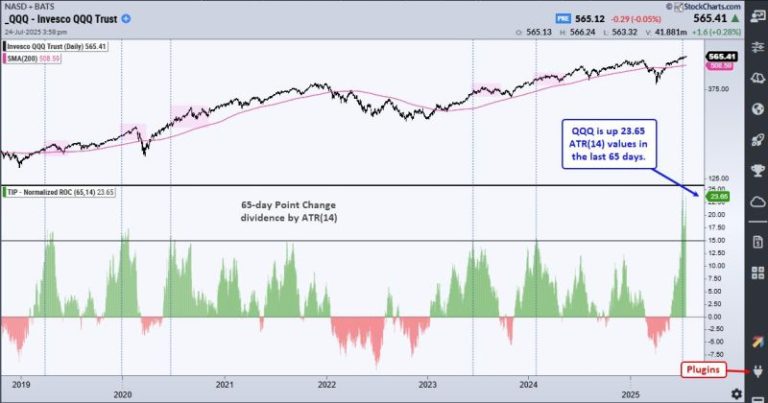
Even though the Utilities SPDR (XLU) cannot keep pace with the Technology SPDR (XLK) and Communication Services SPDR (XLC), it is in a leading uptrend. XLU formed a cup-with-handle from November to July and broke to new highs the last two weeks. ETFs hitting new highs are in strong uptrends and should be on our radar.


Metal Mania in 2025

In a tribute to Ozzy, metals are leading the way higher in 2025. The PerfChart below shows year-to-date performance for the continuous futures for 12 commodities. Copper, Platinum and Palladium are up more than 45% year-to-date, while Gold is up 28.38% and Silver is up 35.30%. QQQ is up 10.52% year-to-date, but lagging these metals. The other commodities are mixed.


Multi-Year Highs for Silver and Copper

The next chart shows 11 year bar charts for five metals. Gold broke out in early 2024 and led the metals move with an advance the last 21 months. Silver and copper broke out to multi-year highs. Platinum broke above its 2021 high and Palladium got in the action with an 18 month high. There is a clear message here: metals are moving higher and leading as a group.  


Home Construction Hits Moment of Truth

The Home Construction ETF (ITB) hit its moment of truth as it rose to its falling 40-week SMA. Notice that ITB failed just below this moving average in August 2023. During the 2023-2024 uptrend, the 40-week SMA was more friendly as ITB reversed near this level in October 2023 and June 2024. ITB surged to the falling 40-week SMA in July, but the long-term trend is down and this area could be its nemesis.

Thanks for Tuning in!

See TrendInvestorPro.com for more


The S&P 500 ($SPX) just logged its fifth straight trading box breakout, which means that, of the five trading ranges the index has experienced since the April lows, all have been resolved to the upside.

How much longer can this last? That’s been the biggest question since the massive April 9 rally. Instead of assuming the market is due to roll over, it’s been more productive to track price action and watch for potential changes along the way. So far, drawdowns have been minimal, and breakouts keep occurring. Nothing in the price action hints at a lasting change — yet.

While some are calling this rally “historic,” we have a recent precedent. Recall that from late 2023 through early 2024, the index had a strong start and gave way to a consistent, steady trend.

From late October 2023 through March 2024, the S&P 500 logged seven consecutive trading box breakouts. That streak finally paused with a pullback from late March to early April, which, as we now know, was only a temporary hiccup. Once the bid returned, the S&P 500 went right back to carving new boxes and climbing higher.

New 52-Week Highs Finally Picking Up

If there’s been one gripe about this rally, it’s that the number of new highs within the index has lagged. As we’ve discussed before, among all the internal breadth indicators available, new highs almost always lag — that’s normal. What we really want to see is whether the number of new highs begins to exceed prior peaks as the market continues to rise, which it has, as shown by the blue line in the chart below.

As of Wednesday’s close, 100 S&P 500 stocks were either at new 52-week highs or within 3% of them. That’s a strong base. We expect this number to continue rising as the market climbs, especially if positive earnings reactions persist across sectors.

Even when we get that first day with 100+ S&P 500 stocks making new 52-week highs, though, it might not be the best time to initiate new longs.

The above chart shows that much needs to align for that many stocks to peak in unison, which has historically led to at least a short-term consolidation, if not deeper pullbacks — as highlighted in yellow. Every time is different, of course, but this is something to keep an eye on in the coming weeks.

Trend Check: GoNoGo Still “Go”

The GoNoGo Trend remains in bullish mode, with the recent countertrend signals having yet to trigger a greater pullback.

Active Bullish Patterns

We still have two live bullish upside targets of 6,555 and 6,745, which could be with us for a while going forward. For the S&P 500 to get there, it will need to form new, smaller versions of the trading boxes.

Failed Bearish Patterns

In the chart below, you can view a rising wedge pattern on the recent price action, the third since April. The prior two wedges broke down briefly and did not lead to a major downturn. The largest pullbacks in each case occurred after the S&P 500 dipped below the lower trendline of the pattern.

The deepest drawdown so far is 3.5%, which is not exactly a game-changer. Without downside follow-through, a classic bearish pattern simply can’t be formed, let alone be broken down from.

We’ll continue to monitor these formations as they develop because, at some point, that will change.

Coinbase Global (NASDAQ:COIN) said on Tuesday (September 16) that it is rolling out rewards on USD Coin (USDC) balances for Canadian users, offering returns of up to 4.5 percent

This marks the first time Canadians can automatically earn interest-like payouts simply by holding USDC on the platform. Coinbase customers in Canada will receive 4.1 percent annualized rewards on their USDC, paid weekly.

Members of Coinbase One, the company’s subscription service, can boost the rate to 4.5 percent on up to US$30,000 in holdings, while any amount above that earns the base 4.1 percent.

There are no lockups or opt-ins required, and users retain full access to withdraw or spend their USDC at any time.

USDC is a stablecoin that is pegged 1:1 to the US dollar and backed by reserves of cash and short-term US treasuries held with regulated institutions. Unlike volatile cryptocurrencies such as Bitcoin, stablecoins are designed to maintain price stability, making them more suitable for payments, savings and yield-generating products.

Angus Reid research conducted for Coinbase in August 2024 shows 83 percent of Canadians believe the global financial system needs an overhaul, while 91 percent think domestic banks prioritize profits over customers’ financial wellbeing.

Coinbase’s Canadian rollout builds on the company’s November 2024 introduction of USDC rewards through Coinbase Wallet, with a 4.7 percent annual yield offered to global users.

At the time, the company highlighted USDC’s utility in combining “the stability of the U.S. dollar with the power and speed of the internet,” enabling instant, borderless transactions.

“Along with earning rewards, you can send USDC on Base instantly and with zero fees,” Coinbase said when it launched the wallet-based program last year, noting that payouts would be deposited monthly into user accounts.

That feature was made available across most regions, including the US.

The wallet program also builds on another strategic advantage of stablecoins: cross-border efficiency. Transactions conducted on blockchain networks like Base, Coinbase’s Ethereum Layer 2 chain, are settled in real time, which means the fees and delays associated with traditional payment rails are sidestepped.

The Canadian launch arrives as stablecoins gain momentum in mainstream finance. Companies including Visa (NYSE:V), PayPal Holdings (NASDAQ:PYPL) and a growing number of fintech platforms have announced integrations in the past year, allowing users to pay, settle or transfer value using tokens like USDC and Tether’s USDT.

Coinbase is betting that frustration with legacy systems, combined with the appeal of higher yields and fast payments, will be enough to tip more users toward digital assets.

Securities Disclosure: I, Giann Liguid, hold no direct investment interest in any company mentioned in this article.

This post appeared first on investingnews.com