Author

admin

Browsing

President Donald Trump delivered a stern ultimatum to Nicolás Maduro to leave Venezuela immediately before announcing the country’s airspace should be closed, according to a report.

Per the Miami Herald, Washington’s warning was delivered in a phone call with Caracas and offered guaranteed evacuation for Maduro, his wife Cilia Flores, and their son, but only if the dictator agreed to resign on the spot. 

The conversation stalled, U.S. officials said, and within hours Washington escalated dramatically. 

The ensuing impasse, a source told the outlet, was over Maduro asking for ‘global amnesty for any crimes he and his group had committed, and that was rejected.’ 

‘Second, they asked to retain control of the armed forces — similar to what happened in Nicaragua in ’91 with Violeta Chamorro. In return, they would allow free elections.’ 

The final issue was timing, according to the outlet, as Washington demanded that Maduro resign immediately – but Caracas refused.

Trump went on to announce Saturday that Venezuelan airspace would be considered ‘closed in its entirety.’ 

The Herald also reported that the Maduro government tried to schedule another call to Washington but received no response.

According to a defense expert familiar with the country’s military and state-linked cartel ties, Maduro and key players in his regime could now face their most serious threat yet.

‘I think the operations will start imminently,’ former Venezuelan diplomat Vanessa Neumann told Fox News Digital.

‘The clearing of the airspace is an indication and a very clear public warning that missiles might be coming to take out command and control infrastructure or retaliatory infrastructure,’ Neumann said. ‘This will not be like breaking a jar into a thousand pieces, this is where you can lift the concentration of power, and it’s easier to manage.’

‘The targets have been identified through covert operations over the last several years by people on the ground,’ she continued. ‘So they’re well-mapped. This is a capture-or-kill scenario, but there’s a limit to how many people you can remove quickly.’

On Sunday, Trump told reporters aboard Air Force One not to ‘read anything into’ his declaring Venezuela’s airspace closed when asked if a strike was imminent. 

‘Maduro also doesn’t have that many options, and his military is very weak,’ she warned. ‘You can’t go after 30 people simultaneously, who are spread all around, but certainly high on the list would be Maduro himself.’

Venezuela’s armed forces, once among Latin America’s strongest, have been weakened by years of corruption, sanctions, defections, and lack of maintenance. Much of its equipment, Neuman says, has never even been serviced.

‘Their material is extremely old, decayed, and has not been serviced,’ Neuman explained. 

‘They’ve got junk from the Russians. The stuff they originally had from the Americans is decades old and has not been serviced.

‘So, they have neither the personnel, foreign support, nor the material,’ she said.

Ahead of shuttering the airspace, the U.S. also officially designated the cartel allegedly linked with Venezuela’s government, the Cartel de los Soles, as a foreign terrorist organization.

‘This cartel turned Venezuela’s main oil company into a narcotics trafficking money laundering operation, using the company’s access to international finance, until it was sanctioned,’ Neuman, who has worked with governments on countering transnational organized crime linked to the group, explained.

‘They were using Venezuelan military jets to bring in cocaine from Colombia, process it in Venezuela, and then move it into Central America and then into Europe.

‘Jet pilots were making a lot of money off that, and they’ve tortured people. They target people, anybody who tell on them, they’re disappeared,’ Neuman said. ‘They’re now one of the prime drug trafficking networks into the United States and Europe, and use their military positions, including their military-to-military relations, to grow and accelerate those movements.’

In fact, in September, the European Parliament also voted in favor of the EU designating Cartel de los Soles as a terrorist organization.

‘The Cartel de Los Soles is also a key collaborator and financier of Hezbollah and some of the drug money has been used to fund terrorist attacks that have killed American citizens, even in the Middle East,’ added Neuman, CEO of Asymmetrica Group, which specializes in defense cooperation.

The U.S. has also ramped up a military and intelligence campaign targeting drug-trafficking networks linked to Venezuela, including strikes on suspected narcotics boats.

‘The decision is President Trump’s because when he says, ‘Go’, we go. And nobody knows when he’ll say that,’ Neuman said. ‘He has mobilized so many assets down there now. But what President Trump is doing now is long overdue.’

‘The timing is right now,’ she added. ‘Because even Maduro’s biggest backers, Russia and Iran, are both on the back foot, and China will not go that far in backing Maduro as it has bigger and broader interests throughout the region.’

She also noted that ‘Maduro is also weakened because his partners are weakened and have their own issues to deal with,’ and that ‘we also now have a concentration of power and deep repression within the country that’s quite unified, which means it’s easy to flip.’

Neuman identified others in the regime who may be targeted, including Vice President Delcy Rodríguez, Diosdado Cabello, Minister of Interior, Justice and Peace and Alexander Granko Arteaga, head of Venezuela’s counter-intelligence agency, the DGCIM.

‘One of the reasons Granko is an important figure is that he’s one of the reasons why they haven’t capitulated and why there has not been a military uprising,’ Neuman explained.

‘It’s because of the brutality of the counter-intelligence that they do to their own military, and hundreds of soldiers are tortured. That said, the Venezuelan people have made it clear that they wanted Maduro out and fought democratically but lost,’ she added.

‘They voted in elections, protested peacefully, lobbied for sanctions, and lobbied for international support,’ Neuman said.

This post appeared first on FOX NEWS

President Donald Trump on Sunday defended Secretary of War Pete Hegseth over allegations he ordered a second strike on a Venezuelan drug boat, saying he believes Hegseth’s denial and would not have supported a follow-up attack if it happened.

The exchange came during a gaggle aboard Air Force One as reporters pressed Trump on claims that Hegseth authorized a second strike that allegedly killed two wounded men after an earlier attack on a suspected drug-smuggling vessel.

Trump repeatedly said Hegseth denied giving such an order. He added that he was aware of the allegation but stressed that Hegseth told him the claim was untrue and that he accepted that explanation without hesitation.

‘He said he did not say that, and I believe him 100%,’ Trump said.

Reporters asked Trump whether he would have approved a second strike if Hegseth had ordered one, prompting him to again distance himself from the allegation while stressing that he trusted his secretary of war.

Trump said he planned to seek additional information about the reported incident but reiterated that Hegseth assured him nothing improper happened.

‘No, I wouldn’t have wanted that. Not a second strike,’ Trump said.

Still, he praised the wider campaign targeting drug-smuggling boats, saying the strikes had sharply reduced the flow of narcotics into the U.S. by sea in recent months.

Trump argued the vessels posed a deadly threat and framed the operations as necessary to protect Americans, calling the missions lethal but justified.

‘You can see the boats,’ he said. ‘You can see the drugs in the boats and each boat is responsible for killing 25,000 Americans.’

Trump went to Hegseth’s defense after reports from outlets such as The Washington Post and CNN claimed the U.S. military ordered a second strike on a suspected drug vessel in the Caribbean on Sept. 2 after the earlier attack left two survivors.

According to The Washington Post, the commander overseeing that operation told colleagues on a secure conference call that the survivors were legitimate targets because they could still contact other traffickers for help and ordered the second strike to comply with what he said was a directive from Hegseth that everyone must be killed.

‘As usual, the fake news is delivering more fabricated, inflammatory and derogatory reporting to discredit our incredible warriors fighting to protect the homeland,’ Hegseth wrote on X on Friday.

‘As we’ve said from the beginning and in every statement, these highly effective strikes are specifically intended to be ‘lethal, kinetic strikes,’’ Hegseth continued. ‘The declared intent is to stop lethal drugs, destroy narco-boats and kill the narco-terrorists who are poisoning the American people. Every trafficker we kill is affiliated with a Designated Terrorist Organization.’

Fox News Digital’s Greg Norman and Alexandra Koch contributed to this report.

This post appeared first on FOX NEWS

Steve Witkoff, the U.S. special envoy to the Middle East, will travel to Moscow on Monday, a U.S. official tells Fox News.

The trip comes as peace talks between Ukraine and Russia show signs of progress, with the White House pushing a peace plan to end the nearly four-year-long war.

On Sunday, Witkoff — a central figure in negotiating the ceasefire between Israel and Hamas — joined Secretary of State Marco Rubio and senior advisor Jared Kushner in Florida to meet with Ukrainian negotiators. 

Rubio described the meeting as ‘very productive.’ In a statement, Rubio said that the end goal is ‘not just the end of the war.’

‘Obviously, that’s essential and fundamental. We want to see the end of the killing and the death and the suffering, and I’m sure the Ukrainian side, I know they do as well,’ Rubio said. 

‘They want peace. But it’s also about securing an end to the war that leaves Ukraine sovereign and independent and with an opportunity at real prosperity.’

Last week, Russia’s Foreign Minister Sergey Lavrov said Moscow could reject the White House’s peace deal framework if it does not uphold the ‘spirit and letter’ of what President Donald Trump and Russian President Vladimir Putin agreed to at the Alaska summit in August.

He warned that if the terms of the ‘key understandings’ are ‘extinguished’ then the situation would become ‘fundamentally different.’

Despite Lavrov’s comments, Putin showed interest in Trump’s plans to end the war on Thursday, calling the drafted plans a starting point.

‘We need to sit down and discuss this seriously,’ Putin told reporters, according to The Associated Press.

Trump’s plan as ‘a set of issues put forward for discussion’ rather than a draft agreement.

‘Every word matters,’ Putin added.

Fox News Digital’s Sarah Tobianski, Kyle Schmidbauer and Ashley Carnahan contributed to this report.

This post appeared first on FOX NEWS

President Donald Trump defended calling Venezuela’s airspace closed, saying the country is sending criminals into the U.S., but told reporters not to ‘read anything into it’ when asked whether the warning suggested an imminent strike.

While speaking to reporters aboard Air Force One on Sunday, Trump said Venezuela is ‘not a very friendly country’ and claimed it has sent criminals, gang members and drug traffickers into the U.S.

On Saturday, Trump told airlines, pilots, drug dealers and human traffickers to ‘consider THE AIRSPACE ABOVE AND SURROUNDING VENEZUELA TO BE CLOSED IN ITS ENTIRETY.’

When asked Sunday if the warning meant an airstrike is imminent, Trump said: ‘Don’t read anything into it.’

Trump also confirmed a report from the New York Times that he spoke on the phone with President Nicolás Maduro, though he offered no details about the conversation.

‘I wouldn’t say it went well or badly,’ he said. ‘It was a phone call.’

The president’s comments come amid rising tensions between the U.S. and Venezuela over Venezuela’s failure to stop drug traffickers from sending narcotics into the U.S.

Since September, the Trump administration has conducted over 20 strikes against alleged drug boats in Latin American waters and beefed up its military presence in the Caribbean as part of Trump’s effort to crack down on the flow of drugs into the U.S.

The strikes have brought the total number of suspected narco-terrorists eliminated to over 82, with three survivors.

But as the U.S. continues to bolster forces in the waters off Venezuela, Maduro has called for peace but also remained defiant against what he called ‘imperialist aggression.’

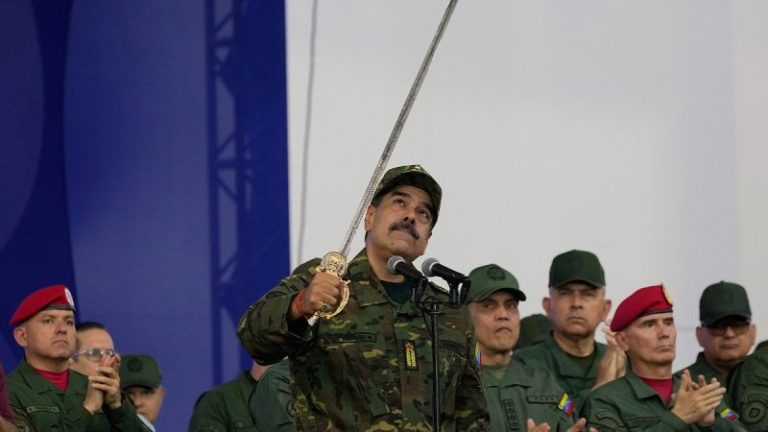
Maduro delivered an address in Caracas last week while brandishing a sword and warning supporters to prepare for confrontation, saying the U.S. will ‘very soon’ begin stopping suspected Venezuelan drug traffickers on land.

He appeared at a mass rally in the capital holding the sword of Simón Bolívar, the 19th-century independence leader regarded as the liberator of much of South America. Maduro told supporters the country was facing a decisive moment.

The Associated Press reported that he said, ‘For anyone, whether civilian, politician, military, or police –  Let no one make excuses. Failure is not an option. The homeland demands it! Our greatest effort and sacrifice. And with (Simón) Bolívar, I come to say that if the homeland demands it, the homeland will have our lives, if necessary,’ he declared while raising Bolívar’s sword.

Maduro framed the situation as a struggle against what he described as external threats, urging Venezuelans to mobilize against any foreign aggression.

Fox News Digital’s Diana Stancy and Efrat Lachter contributed to this report.

This post appeared first on FOX NEWS

Official peace talks between the U.S. and Ukraine on ending the Ukraine war moved to a productive phase Sunday – but only after President Zelenskyy sent a new-look team to Florida, according to a former Ukrainian government official.

With Rustem Umerov now leading Zelenskyy’s team and longtime adviser and chief of staff Andriy Yermak out, the source claimed the move signaled Kyiv was reassessing its ‘uncompromising’ stance.

The official, who spoke to Fox News Digital on condition of anonymity, said the personnel choice represented a move away from the approach that has shaped Ukraine’s diplomatic strategy for years.

‘Yermak had been teaching Zelenskyy to be a ‘Father of the Nation’ and until now, the Ukrainian side has been pushing for an unachievable and uncompromising position,’ the former official said.

‘Umerov is not a very impressively strong individual in politics, but he wants to achieve results and is known to be aligned with compromise.’

Ukraine’s new delegation also included Andrii Hnatov, head of the armed forces; Andrii Sybiha, the foreign minister; and Umerov, who is head of the country’s security council.

After the meeting, Umerov offered a brief assessment to reporters, saying: ‘We are grateful to American people, American leadership and a great team with, state secretary, Steve, with both Jared Kushner for their tremendous work with us,’ he said.

‘Our objective is a prosperous, strong Ukraine. We will [be] discussing [sic] the future of Ukraine. We discussed all the important matters that are important for Ukraine, for Ukrainian people. And the U.S was super supportive.’

We already had a successful meeting in Geneva, and today we can continue this success. So at the moment, this meeting was productive and successful in the later stages.’

The new team traveled to Florida for discussions aimed at refining President Trump’s proposed framework and his push to end Russia’s war against Ukraine.

Sunday’s negotiations also took place after a leak published by Bloomberg News, revealed a transcript of an Oct. 14 call where special envoy Steve Witkoff allegedly offered advice to Russian officials on how to sell a peace plan to Trump.

‘The Ukrainian side had in some way undermined peace negotiations and Donald Trump’s efforts, not mentioning that it prolongs the war,’ the former official said.

The same former official said the shift in Kyiv’s delegation followed the dramatic resignation of Yermak, after anti-corruption investigators raided his home on Friday.

‘Yermak was deeply distrusted by many actors, including Western actors including the U.S. administration and including Biden’s administration,’ the source added.

Despite his exit, the official warned that Yermak’s influence may still be shaping the Ukrainian team.

‘Mr. Yermak is still there and, in fact, all the delegation that came to Florida includes Mr. Yermak’s people, his loyal people, very close personally to him –  people who [have] been serving him faithfully for years.’

‘Yermak has not disappeared and might be on the telephone or online and ruling the agenda behind the scenes,’ they added.

They said Yermak’s long-standing governing style still influences Kyiv’s political posture:

‘In Ukraine, as in many post-Soviet countries, there is still the so-called ‘telephone rule’, when a powerful person can influence the outcome of any formal decision-making despite lacking formal powers and in contradiction with the law.’

‘Yermak has been doing this for the last six and a half years,’ the source added.

Secretary of State Marco Rubio, Witkoff, and senior advisor Jared Kushner led the American side in Sunday’s session.

Rubio told reporters after the meeting: ‘We had another very productive session. Building off Geneva, building off the events of this week,’ he said.

‘As I told you earlier this morning, our goal here is to end the war,’ he continued. ‘But it’s more than just to end the war. We don’t just want to end the war. We also want to help Ukraine be safe forever. So never again will they face another invasion. And equally importantly, we want them to enter an age of true prosperity.’

Trump told reporters aboard Air Force One on Sunday that he had spoken to Rubio and Witkoff and that they were ‘doing well.’

‘Ukraine’s got some difficult little problems,’ Trump said. ‘They have some difficult problems. But I think Russia would like to see it end and I think Ukraine… I know Ukraine would like to see it end.’

He also said he thinks there is ‘a good chance we can make a deal.’

In a post shared on X, Zelenskyy highlighted Umerov’s work in Florida as the head of the Ukrainian delegation.

‘Today, following the work of the teams in the United States, head of the Ukrainian delegation Rustem Umerov reported on the main parameters of the dialogue, its emphases, and some preliminary results,’ he said.

‘It is important that the talks have a constructive dynamic and that all issues were discussed openly and with a clear focus on ensuring Ukraine’s sovereignty and national interests. I am grateful to the United States, to President Trump’s team, and to the President personally for the time that is being invested so intensively in defining the steps to end the war. We will continue working. I look forward to receiving a full report from our team during a personal meeting.’

Sunday’s talks came just hours after another deadly Russian strike on Kyiv killed at least one person and wounded 19, including four children, Euronews reported.

Since Russia’s full-scale invasion in 2022, the war has left huge areas of Ukraine devastated and roughly 20% of its territory under occupation.

This post appeared first on FOX NEWS

The Trump administration harshly criticized the United Kingdom over its handling of mass immigration and the long-running rape gang scandal that has victimized white girls across the country.

In a statement posted to X, the U.S. State Department called on its Europe-based diplomats to track the effects of rampant immigration. While the statement zeroed in on the U.K., it also highlighted similar problems in Germany and Sweden.

‘The State Department instructed U.S. embassies to report on the human rights implications and public safety impacts of mass migration,’ the statement read. ‘Officials will also report policies that punish citizens who object to continued mass migration and document crimes and human rights abuses committed by people of a migration background.’

The statement referenced the so-called ‘grooming gangs’ made up of mostly Pakistani men who have victimized young girls for decades, with little action taken by the government.

‘In the United Kingdom, thousands of girls have been victimized in Rotherham, Oxford, and Newcastle by grooming gangs involving migrant men,’ the State Department said. ‘Many girls were left to suffer unspeakable abuse for years before authorities stepped in.’

A day after the statement, GB News reported that U.K. Prime Minister Keir Starmer told reporters at the G20 in South Africa that the national inquiry would ‘leave no stone unturned.’

The State Department’s warning comes weeks after several victims — who were members of the independent inquiry — resigned over what they claimed was a continuation of a cover-up. 

One abuse survivor, Ellie Reynolds, told cable channel GMB that the existence of grooming gangs has been ‘brushed under the carpet’ and that ‘our voices have been silenced.’

She was supported by fellow survivor Fiona Goddard, who was groomed from the age of 14, and said that when she spoke out for help she was dismissed as a ‘child prostitute’ by authorities.

Goddard resigned to protest the cover-up, saying members of the grooming gangs near Bradford were in the ‘vast majority … Pakistani men.’

Successive governments — both Conservative and Labour — have been dealing with the revelations for years that a number of grooming gangs, often consisting mostly of men of South Asian or Pakistani heritage, have sexually exploited girls for decades across the north of England.

Prior to the inquiry, Starmer had commissioned a national audit led by Baroness Louise Casey earlier this year. 

On the hot-button issue of the backgrounds of the criminals, the Casey report stated in part, ‘We found that the ethnicity of perpetrators is shied away from and is still not recorded for two-thirds of perpetrators, so we are unable to provide any accurate assessment from the nationally collected data.’

It continued: ‘Despite the lack of a full picture in the national data sets, there is enough evidence available in local police data in three police force areas which we examined which show disproportionate numbers of men from Asian ethnic backgrounds amongst suspects for group-based child sexual exploitation, as well as in the significant number of perpetrators of Asian ethnicity identified in local reviews and high-profile child sexual exploitation prosecutions across the country, to at least warrant further examination.’

Her audit also identified other perpetrators, including White British, European, African or Middle Eastern individuals.

The results of the audit produced 12 recommendations to the government, which have been implemented, including a national inquiry to ‘direct local investigations and hold institutions to account for past failures.’ 

But the Starmer government has been set back by a failure to appoint a chair for the inquiry, and it has faced resignations as critics have accused the Labour government of covering it up for political reasons.

Alan Mendoza, founder of the Henry Jackson Society, told Fox News Digital that ‘successive governments’ have allowed ‘gangs of largely South Asian Muslims to target white British girls, claiming, ‘the Labour government doesn’t want to be seen as stigmatizing demographics or potentially losing votes.’

‘I hope that the inquiry will focus more specifically on the real issue plaguing the U.K. over the last 20 years,’ Mendoza added.

The point person for the government’s inquiry is Labour member of Parliament Jess Phillips, who has served as the parliamentary undersecretary of state for Safeguarding and Violence Against Women and Girls since July 2024.

However, Phillips is facing heavy scrutiny over how she’s handling the set-up of the inquiry.

Asked in Parliament about the nature of the inquiry and whether it will address the perpetrators’ ethnicity, she vowed to be transparent.

‘There is absolutely no sense that ethnicity will be buried away,’ Phillips said. ‘Every single time that there is an apparently needless delay — even though it took seven months to put in place chairs for both the COVID inquiry and the blood inquiry, and nobody moaned about that — it gets used to say that we want to cover something up. That is the misinformation I am talking about. It will not cover things up. We are taking time to ensure that that can never happen.’

Elon Musk weighed in on the matter in a series of X statements earlier this year, stating that Phillips, was a ‘rape genocide apologist’ and the world was witnessing ‘the worst mass crime against the people of Britain ever.’ 

Philips told the BBC that his comments were ‘disinformation’ and ‘endangering’ her, but said it was nothing compared to what the victims of the abuse had faced. 

Commentators say the challenge for the government now is to find those credible and willing to bring justice and lasting change so it won’t happen again.

Fox News Digital reached out to Phillips’ office but received no response.
 

This post appeared first on FOX NEWS

Fulton County District Attorney Fani Willis, an elected Democrat, is a disgrace to her office and the legal profession. She to bring down President Trump with a politically motivated indictment, but her vendetta came crashing to a pitiful end on Wednesday. Now, it is time for Willis to face maximum legal accountability.

Trump vigorously objected to the results of the 2020 presidential election in several states and during the Congressional certification process. He offered no bribes and made no threats of violence; indeed, he urged his supporters to march ‘peacefully’ to the Capitol on January 6, 2021, the day of the certification. Yet, Willis—a leftist hack—secured an indictment against Trump and many of his allies with an overwhelming Democrat grand jury in Atlanta. These included Trump’s loyal White House chief of staff Mark Meadows; Jeff Clark, an exceptional former top Justice Department official who is facing a disgraceful disbarment effort by the District of Columbia Bar; and former New York City Mayor Rudy Giuliani, America’s greatest mayor who served as one of President Trump’s attorneys. Willis alleged a vast RICO conspiracy that could have landed President Trump and his supporters in prison for decades.

Willis had ethical issues even before her indictment. Lt. Gov. Burt Jones was one of her targets, but she never got the chance to persecute him. Fulton County Superior Court Judge Robert McBurney disqualified Willis because she had fundraised for Jones’ Democrat opponent. This disqualification was an easy call; indeed, McBurney expressed incredulity as to what Willis possibly could have been thinking. Pete Skandalakis, head of the Prosecuting Attorneys’ Council of Georgia (PACGA), took over the case and dismissed it after determining that Jones had not acted with criminal intent. This shameful episode would not be Willis’s most shocking lapse in judgment during this fiasco.

Willis hired her secret (and married) boyfriend Nathan Wade, who had never tried a felony case. He had been a lawyer in private practice and a municipal court judge. Somehow, he found his way onto Willis’s team, raking in $250 an hour from Fulton County taxpayers. He billed eight-hour days constantly, and he even billed 24 hours on one occasion. He wound up taking home almost $700,000. He made far more money than John Floyd, Georgia’s preeminent expert on the RICO statute. The mystery of Wade’s involvement was solved thanks to Ashleigh Merchant, an excellent attorney who represented one of Trump’s co-defendants and American patriotic warrior Mike Roman.  Merchant alleged that Willis and Wade had been having an affair and filed a motion for their disqualification.

Leftist legal analysts like the insufferable Norm Eisen scoffed at Merchant when she filed her motion. The prosecution even sought sanctions. Superior Court Judge Scott McAfee did not issue sanctions; instead, he held an evidentiary hearing. The hearing was a national disgrace. Willis could not control her rage, and McAfee had to caution her to stop her antics. The proceedings degenerated into an episode of Jerry Springer, and the salacious details of the affair were broadcast for the nation to see. Wade paid for lavish trips to the Caribbean and other luxurious places. Willis claimed that she had reimbursed Wade with cash that she kept in her house at the direction of her father, a prominent Black Panther. There are no records of any of these purported reimbursements. Willis also claimed the affair had nothing to do with the indictment, testifying that it only started after Wade’s appointment.

McAfee used the phrase ‘odor of mendacity’ to describe the testimony of Willis and Wade. He sadly split the baby, ruling that one of them would be disqualified. Wade resigned that day, meaning that Willis could stay on the case. President Trump and most codefendants appealed the decision not to disqualify Willis, and an appellate court agreed with the defendants. Willis sought review by the Georgia Supreme Court, but the justices rebuffed her earlier this year. The case was then reassigned to PACGA. Skandalakis could not find a prosecutor to take it over, so he assigned it to himself. The day before Thanksgiving, McAfee granted Skandalakis’ motion to dismiss the case in its entirety. Willis secured a few plea deals to misdemeanor charges, a pathetic result given the fanfare that the indictment initially received. Willis promised that ‘[t]he train is coming,’ but her staggering corruption, arrogance, and incompetence derailed the train.

Willis’s sham indictment devastated many lives. People with not nearly the resources of Trump faced indictment and had to shell out massive amounts to pay lawyers. They had their lives destroyed. The dismissal cannot be the last word here, and Trump’s attorney, the brilliant Steve Sadow, has made that clear. He will move for attorney’s fees and costs under Georgia Code § 17-11-6. Such fees are proper because Willis was disqualified for improper conduct, and the case was fully dismissed. Every other defendant should join Sadow’s motion. Additionally, Willis and Wade must face severe criminal accountability by the U.S. Justice Department for a conspiracy against rights under 18 U.S.C. § 241. Wade visited the Biden White House, billing 16 hours of his time to the taxpayers of Fulton County. What happened here is obvious. Willis and Wade were coordinating their farcical prosecution with Team Biden. It could not have been for any other reason, as Wade was hired as a special counsel just for this case. If Wade were billing his time to Fulton County taxpayers for his Biden White House meeting for an unrelated matter to the Trump case, Wade committed fraud. Willis hired her lover, who kicked back some of his unearned salary to finance lavish trips for himself and Willis. The U.S. Justice Department has subpoenaed records from Willis, and a grand jury must promptly investigate and indict these corrupt public (dis-)servants.

President Trump objected to an election he thought had been stolen. Democrats did the same in 1969, 2001, 2005, and 2017—yet, none faced indictment. Such objections are allowed under the First Amendment and the Electoral Count Act. It is only illegal to object to elections in third-world Marxist hellholes. Willis and Wade were neck-deep in the Republic-ending lawfare conspiracy against Trump that tore apart our nation. They failed, but they cannot walk away from their despicable actions. Justice must come their way swiftly and severely. They could not wait to post President Trump’s mugshot, and the time has come for theirs.

Lawyer up, Fani. Justice is coming. Nobody is above the law.

This post appeared first on FOX NEWS

Statistics Canada released third-quarter gross domestic product (GDP) figures on Friday (November 28). The data showed that the economy grew by 0.6 percent over the three-month period, following a 0.5 percent decrease in the preceding quarter.

The agency attributed the gain to lower imports and higher exports. Leading declines were caused by a drop in imports of unwrought precious metals, industrial machinery, equipment and parts, while exports of crude oil and bitumen increased 6.7 percent.

Government capital investments were also up, gaining 2.9 percent, headlined by an 82 percent increase in spending on weapon systems. However, private sector investment was essentially flat, with an increase in residential and engineering structures offset by declines in machinery and equipment, non-residential building and intellectual property.

The agency also released a more detailed monthly breakdown of GDP by industry. In September, the oil and gas subsector posted growth of 1.3 percent while support activities rose 1.6 percent. These gains offset a 2.2 percent contraction in the mining and quarrying subsector. Leading the decrease was a 3.9 percent decrease in non-metallic minerals, highlighted by a 4.9 percent fall off in potash mining.

The GDP news comes just a day after the Federal government and Alberta government signed a memorandum of understanding (MoU) that will see increased support for initiatives in Alberta’s oil and gas sector.

Under the terms of the agreement, the two levels of government will work with the private sector and Indigenous co-ownership to build a pipeline to British Columbia’s North Coast to support the export of 1 million barrels of oil per day to Asian markets. It will also seek to expand the Trans Mountain pipeline to carry up to an additional 400,000 barrels per day.

Additionally, the deal will see significant increases to Alberta’s industrial carbon tax and has caveats that, among other conditions, must be met, including the completion of the Pathways carbon capture and storage projects.

The realism of the MoU’s goals remains uncertain, as the Government of British Columbia and First Nations along the northern coast of the province have expressed their opposition to the project, especially the suspension of the tanker ban through ecologically sensitive and hard-to-navigate waters.

For more on what’s moving markets this week, check out our top market news round-up.

Markets and commodities react

Canadian equity markets surged this week.

The S&P/TSX Composite Index (INDEXTSI:OSPTX) gained 4.84 percent over the week to close Friday (November 21) at 31,382.78.

Meanwhile, the S&P/TSX Venture Composite Index (INDEXTSI:JX) soared 10.57 percent to 937.34. The CSE Composite Index (CSE:CSECOMP) also improved this week, rising 2.22 percent to close at 149.37.

The gold price rose 3.5 percent to US$4,218.77 by 4:00 p.m. EST Friday. The silver price fared even better, surging 11.39 percent to a new record high of US$56.37.

Meanwhile, in base metals, the COMEX copper price ended the week up 3.74 percent at US$5.27 per pound.

The S&P Goldman Sachs Commodities Index (INDEXSP:SPGSCI) gained 0.71 percent to end Friday at 555.16.

Top Canadian mining stocks this week

How did mining stocks perform against this backdrop?

Take a look at this week’s five best-performing Canadian mining stocks below.

Stocks data for this article was retrieved at 4:00 p.m. EST on Friday using TradingView’s stock screener. Only companies trading on the TSX, TSXV and CSE with market caps greater than C$10 million are included. Mineral companies within the non-energy minerals, energy minerals, process industry and producer manufacturing sectors were considered.

1. Mountain Province Diamonds (TSX:MPVD)

Weekly gain: 114.29 percent
Market cap: C$19.11 million
Share price: C$0.075

Mountain Province Diamonds is a mining company with a 49 percent ownership stake in the Gahcho Kué diamond mine in the Northwest Territories, Canada.

The mine, a joint venture with Anglo American (LSE:AAL,OTC Pink:NGLOY) subsidiary De Beers, which owns the other 51 percent, consists of five mining leases covering a total area of 5,216 hectares.

According to a September 2024 technical report, the mine hosts a total indicated resource of 36.4 million carats with an average grade of 1.7 carats per metric ton (c/t) from 21.4 million metric tons of ore, with an additional inferred resource of 23.7 million carats with a grade of 1.79 c/t from 13.3 million metric ton.

In the company’s Q3 report released on November 11, Mountain Province stated that it sold 409,081 carats and raised total proceeds of C$29.2 million at an average price of C$71 per carat.

The company noted that production at the mine was 12 percent lower than the same period last year due to lower than expected stockpile grades; however, grades are expected to improve in Q4 as mining operations began in the higher-grade 5034-NEX orebody.

The most recent news from the company came on November 18, when it amended the terms of its working capital facility with Dunebridge Worldwide. Under the new terms, the company will be able to access additional funds, and it extends the period it can make advances to March 31, 2026.

2. SPC Nickel (TSXV:SPC)

Weekly gain: 100 percent
Market cap: C$23.92 million
Share price: C$0.07

SPC Nickel is an exploration company advancing a pair of projects in Nunavut and Ontario, Canada.

Its Muskox property is a copper, nickel and platinum group metals (PGM) exploration project in Nunavut, consisting of 26 mining claims and two prospector permits covering a total land area of 49,600 hectares. Mineralization at the site was first identified in the 1950s.

The company is also working on its advanced-stage Lockerby East project near Sudbury, Ontario.

A March 2024 resource estimate demonstrates an indicated in-pit resource of 179.1 million pounds of nickel from 19.23 million metric tons with an average grade of 0.42 percent nickel and an out-of-pit resource of 45.7 million pounds of nickel from 3.24 million metric tons grading 0.64 percent from the West Graham target. At the LKE deposit, the estimate shows an additional 17.2 million pounds of nickel from 665,000 metric tons grading 1.17 percent at the LKE deposit.

On Monday (November 24), SPC released assay results from its 2025 exploration program at Muskox. The company stated that the site demonstrated high-grade copper, nickel and PGM mineralization across multiple targets at the 125 kilometer Muskox intrusion.

The company collected 77 grab samples, with 39 returning grades greater than 2 percent nickel and copper, including 19 with grades greater than 5 percent nickel and copper. Additionally, 21 returned PGM grades higher than 5 grams per metric ton.

3. AJN Resources (CSE:AJN)

Weekly gain: 80.95 percent
Market cap: C$12 million
Share price: C$0.19

AJN Resources is an exploration company advancing work at the Otoke gold project in Southern Ethiopia. It also holds option agreements for several lithium projects in the Democratic Republic of Congo and Nevada, US.

The company is currently carrying out due diligence work at the 42.8 square kilometer Otoke gold property as part of a May 2025 conditional heads of agreement that could see AJN earn a 70 percent interest from Godu General Trading.

AJN has 90 days from the start of the due diligence period to drill 1,500 meters. After completing its due diligence, AJN is required to commit to several terms, including an initial US$2 million exploration program and the delivery of a mineral reserve estimate to earn the first 60 percent.

AJN can then acquire an additional 10 percent by meeting certain conditions including payments totalling US$10 million and the completion of a definitive feasibility study.

The most recent update from fieldwork at Otoke came on October 14, when AJN announced that mapping and sampling identified several mineralized zones. Additionally, artisanal workings within the project area have bolstered confidence in the property’s shallow, high-grade potential.

The company said that it collected more than 600 samples, which it submitted to a lab in Ireland, and that it was preparing to mobilize a drill rig within the next two to three weeks.

On November 19, the company announced that it had closed a non-brokered private placement for C$3 million, which will be used for due diligence activities.

4. Bear Creek Mining (TSXV:BCM)

Weekly gain: 65.38 percent
Market cap: C$93.5 million
Share price: C$0.43

Bear Creek Mining is a production company that operates the Mercedes gold and silver mine in Sonora, Mexico.

The mine sites comprise 43 mineral concessions covering 69,284 hectares in a region along the US–Mexico border.

The property hosts potential for both brownfield and greenfield exploration, and according to a September 2024 technical report, it hosts proven and probable reserves of 428,000 metric tons of ore containing 54,000 ounces of gold and 312,000 ounces of silver with grades of 3.95 g/t gold and 22.71 g/t silver.

On November 11, Bear Creek released its Q3 financial and operational results, which highlighted production of 6,219 ounces of gold and 18,866 ounces of silver during the quarter.

The company’s share price gains come alongside large increases in gold and silver prices during the week.

5. Karnalyte Resources (TSX:KRN)

Weekly gain: 65.38 percent
Market cap: C$93.5 million
Share price: C$0.43

Karnalyte Resources is an exploration and development company advancing its Wynyard potash project in Central Saskatchewan, Canada.

The property consists of three primary mineral leases covering 367 square kilometers east of Saskatoon.

Shares in Karnalyte climbed this week after the company released an updated feasibility study for the project on Wednesday (November 26). The study demonstrated economic viability, according to Karnalyte, with an after-tax net present value of C$2.04 billion, an internal rate of return of 12.5 percent, a payback period of 8.8 years, and a mine life of 70 years.

The company also stated that development would benefit from a secured offtake agreement under which India-based GFSC would purchase 350,000 metric tons per year during Phase 1, with additional commitments for 250,000 metric tons per year after Phase 2 is complete.

FAQs for Canadian mining stocks

What is the difference between the TSX and TSXV?

The TSX, or Toronto Stock Exchange, is used by senior companies with larger market caps, and the TSXV, or TSX Venture Exchange, is used by smaller-cap companies. Companies listed on the TSXV can graduate to the senior exchange.

How many mining companies are listed on the TSX and TSXV?

As of May 2025, there were 1,565 companies listed on the TSXV, 910 of which were mining companies. Comparatively, the TSX was home to 1,899 companies, with 181 of those being mining companies.

Together, the TSX and TSXV host around 40 percent of the world’s public mining companies.

How much does it cost to list on the TSXV?

There are a variety of different fees that companies must pay to list on the TSXV, and according to the exchange, they can vary based on the transaction’s nature and complexity. The listing fee alone will most likely cost between C$10,000 to C$70,000. Accounting and auditing fees could rack up between C$25,000 and C$100,000, while legal fees are expected to be over C$75,000 and an underwriters’ commission may hit up to 12 percent.

The exchange lists a handful of other fees and expenses companies can expect, including but not limited to security commission and transfer agency fees, investor relations costs and director and officer liability insurance.

These are all just for the initial listing, of course. There are ongoing expenses once companies are trading, such as sustaining fees and additional listing fees, plus the costs associated with filing regular reports.

How do you trade on the TSXV?

Investors can trade on the TSXV the way they would trade stocks on any exchange. This means they can use a stock broker or an individual investment account to buy and sell shares of TSXV-listed companies during the exchange’s trading hours.

Article by Dean Belder; FAQs by Lauren Kelly.

Securities Disclosure: I, Dean Belder, hold no direct investment interest in any company mentioned in this article.

Securities Disclosure: I, Lauren Kelly, hold no direct investment interest in any company mentioned in this article.

This post appeared first on investingnews.com

South Harz Potash Limited (ASX:SHP) (South Harz or the Company) is pleased to announce that it has entered into an option heads of agreement to acquire the Glava Copper-Gold-Silver project in south-western Sweden. The acquisition marks the first step in the Company’s transition toward a diversified, multi-asset exploration and development strategy.

South Harz Executive Chairman Mr Len Jubber, commented:

“The Glava acquisition option represents an exciting milestone and opportunity for South Harz to leverage our European footprint into one of the most geologically prospective and underexplored copper-gold provinces in Scandinavia. This first step transforms South Harz into a diversified resources company, moving from a single asset company towards a broader regional platform. While we maintain strategic patience with our large-scale South Harz Potash Project, we are broadening our portfolio to include metals essential to global supply chains and the energy transition.

The Glava Project offers immediate discovery potential, hosting visible bornite, covellite, and chalcocite epithermal mineralisation with gold, silver and tellurium in outcropping vein systems, including historic
artisanal production of over 10% copper. Negligible glacial till allows for the use of proven, cost-effective exploration techniques. Initial field activities, including a magnetic survey have been completed under
the guidance of McKnight Resources and we look forward to analysing and interpreting the gathered information in the coming weeks. We are committed to systematically exploring Glava’s potential, while continuing to evaluate complementary opportunities to strengthen the portfolio and create sustained shareholder value.”

Highlights

  • Option Agreement executed to acquire Glava Cu-Au-Ag Project, located in Värmland Province, Sweden
  • First potential acquisition under South Harz’s diversified asset growth strategy, expanding its portfolio into critical (base) and precious metals alongside German potash assets
  • High-grade epithermal copper mineralisation, with associated gold, silver and tellurium, confirmed by recent sampling. Historic artisanal mining recorded up to 10.5% Cu
  • Negligible glacial till allows for use of proven, cost-effective exploration techniques
  • Ground magnetic survey and rock chip sampling completed in November 2025, with results to feed into drill target generation
  • Option Agreement includes strategic relationship with vendors McKnight Resources AB, resulting in established and experienced exploration capability in Sweden
  • The potential acquisition delivers immediate discovery opportunity, while preserving the long term value and optionality in the perpetual tenure across the SHP German potash projects

The Glava Project

The Glava Project, which is located in Sweden’s Värmland region (Figure 1), covers 430Ha under a single exploration licence within the eastern extensions of the Proterozoic Grenville Orogenic Belt, an emerging copper-gold exploration district extending through Scandinavia, the UK, Greenland and Newfoundland.

The project area comprises a highly prospective and underexplored copper-gold system with a history of high-grade artisanal production. It hosts outcropping bornite, covellite and chalcocite mineralisation, and visible tellurides, as described in the Sweden Geologiocal Survey (SGU) database, at two mineral occurrences, namely Glava Koppagruvor and Skarpning SV Glava (Figure 1). The telluride minerals are frequently a component of epithermal deposits. This acquisition gives South Harz immediate exploration access to critical and precious metals in a Tier-1 European jurisdiction.

Historic records show that artisanal mining at Glava Koppargruvor produced about 2,280 tonnes of rock, including 49 tonnes with a grade of 10.5% Cu, as well as additional enriched ore stockpiles from shallow early 20th-century workings (Lundegårdh 1995). Two main accessible shallow open pits (East and West), together with an abandoned 14m deep shaft, provided opportunities for a modern assessment of the geological setting and sampling of the material on the adjacent waste dumps (Figure 2). Mineralisation is structurally controlled along a north-south oriented fracture array that intersects the shallow-south-dipping meta-sediment host rocks. The target zone is interpreted to be dipping towards the south (refer Figure 2, Longitudinal Section).

Click here for the full ASX Release

This post appeared first on investingnews.com
Silver missed the Black Friday sale memo, rising to a new all-time high of US$56.86 per ounce.

The white metal’s price rise came after CME Group (NASDAQ:CME) halted trading on the Comex on Friday (November 28), citing a ‘cooling issue’ at a CyrusOne data center located in a Chicago suburb.

‘On November 27, our CHI1 facility experienced a chiller plant failure affecting multiple cooling units,’ a CyrusOne spokesperson explained to CNBC in an email. “Our engineering teams, along with specialized mechanical contractors, are on-site working to restore full cooling capacity. We have successfully restarted several chillers at limited capacity and have deployed temporary cooling equipment to supplement our permanent systems.”

A CME Group X post shows that by 5:46 a.m. PST, all markets were open and trading.

According to Reuters, the outage is one of the longest in years for CME Group.

Some traders are taking the disruption as a reminder of the market’s strong reliance on systems that don’t always run perfectly. However, others have pointed out that thinner activity in the US due to Thursday’s (November 27) Thanksgiving holiday likely helped minimize the impact of the stoppage.

‘If there was to be a glitch day, today’s probably a good day to have it,’ Joe Saluzzi, co-manager of trading at Themis Trading in Chatham, New Jersey, told the news outlet.

Silver price chart, November 27 to 28, 2025.

While silver is known for lagging behind gold before outperforming, it’s now ahead of its sister metal in terms of percentage gains — silver is up about 84 percent year-to-date, while gold has risen around 58 percent.

Gold was also on the move on Friday, breaking back above US$4,200 per ounce for the first time since mid-November, but it remains below its all-time high of nearly US$4,400, set in October.

Silver’s breakout this year has been driven by various factors.

As a precious metal, it’s influenced by many of the same factors as gold, but its October price jump, which took it past the US$50 level, was also driven by a lack of liquidity in the London market.

While that issue appears to have resolved, a new situation has recently emerged — Bloomberg reported on Tuesday (November 25) that Chinese silver stockpiles are now at their lowest level in a decade after huge shipments to London.

Tariff concerns and silver’s new status as a critical mineral in the US have also provided support in 2025.

The white metal’s industrial side also shouldn’t be forgotten — according to the Silver Institute, industrial demand for silver reached a record 680.5 million ounces in 2024, driven by usage in grid infrastructure, vehicle electrification and photovoltaics. Total silver demand was down 3 percent year-on-year in 2024, but still exceeded supply for the fourth year in a row, resulting in a deficit of 148.9 million ounces for the year.

Watch five experts share their thoughts on the outlook for silver.

Time will tell what’s next for silver, but some experts see it continuing to outperform gold in 2026.

‘The sure money is made in the gold sector, but the big money is made in the silver sector — that’s proven true over the last couple of precious metals cycles. I believe it will be true in this one as well,’ said Jay Martin of VRIC Media.

Securities Disclosure: I, Charlotte McLeod, hold no direct investment interest in any company mentioned in this article.

This post appeared first on investingnews.com